

How a Cybercrime Detective-Turned-Web Designer Runs a 60-Client Agency Solo
 Joella Dunn
Joella Dunn
Joella Dunn
 John Turner
John Turner
John Turner
Jürgen Eick advises companies on cybercrime prevention for a living. He’s a Detective Chief Inspector in Germany’s Ruhr region, the kind of career that doesn’t usually leave room for a second one.
He has one anyway. For years, alongside that job, he’s quietly run a web design agency, solo, with a client list that kept growing whether he had the hours for it or not.
There was never enough time to spare for the slow parts of the job. Duplicator is a big part of how the math still works.
An Introduction to Jürgen Eick
Jürgen Eick started appareas webdesign 15 years ago as a side venture alongside his full-time job.

He spent years as a police officer with the Essen Police Department in Germany’s Ruhr region. There, he shared responsibility for technical operations, managing a team that provided IT support for 2,600 police department personnel.
Ten years ago, he moved into cybercrime prevention as a Detective Chief Inspector, advising companies and corporations on cybersecurity.
With a career like that, web design was always going to be squeezed into whatever time was left over.
For my web development hobby, this meant I had very little time to spare for building websites and supporting clients.
Even so, that side project grew. Over the years, appareas webdesign became a business with more than 60 long-term clients relying on Jürgen for development and maintenance.
All of it is managed as a one-man show, with no employees, no team, and no outside support.
Time, in other words, was always the most critical factor in his work.
The Challenge of Moving Projects From Dev to Live
Every finished website project eventually has to leave Jürgen’s development environment and go live. Before Duplicator, that meant manually exporting the database, re-importing it on the live site, and moving every file over FTP.
For a small project (under 800MB), that process took about 2 to 3 hours. Anything over a gigabyte required 4 to 5 hours, assuming nothing went wrong.
If a database ran into export or import compatibility issues, or media files failed partway through the FTP transfer, it could take a lot longer than that.
One project made the problem impossible to ignore: a photographer’s site built around time-lapse videos, with file sizes large enough that transfers routinely timed out.
Moving it meant babysitting the upload in manual batches, watching for failures the whole time.
Multiply that by more than 60 clients, on top of a full-time career, and the time cost stopped being a minor annoyance.
Moving Faster From Dev to Live With Duplicator
Then, he found Duplicator.
Duplicator solved all these problems at once — and did even more.
Instead of manually moving files and hoping a new host’s database would cooperate, Jürgen could package a finished project and move it to the live server directly. The compatibility guesswork that used to slow him down went away along with the rest of the manual work.
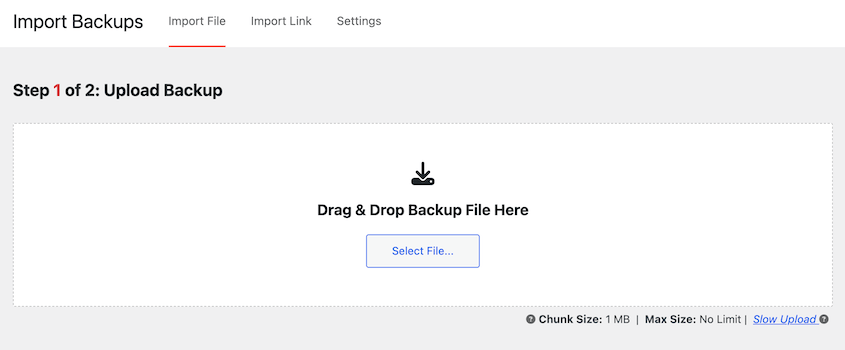
What used to take hours now takes 15 to 20 minutes, even for larger projects. The photographer’s time-lapse site, once a manual, closely supervised ordeal, now moves the same way as everything else.
The database problems went away too, including trickier cases like modernizing a database or switching formats like MySQL to MariaDB.
Duplicator also gave him things he hadn’t had before: automated backups and the ability to pull external client sites into his development environment whenever they need a redesign.
It wasn’t just about saving time and solving problems; I gained new features I hadn’t had before.
Backups run by themselves, usually once a month, across all of his more than 60 client sites. Each backup saves locally on the client’s server. At the same time, a copy uploads to Jürgen’s OneDrive account, which syncs automatically to his hard drive too.
One backup, three separate places it lives.
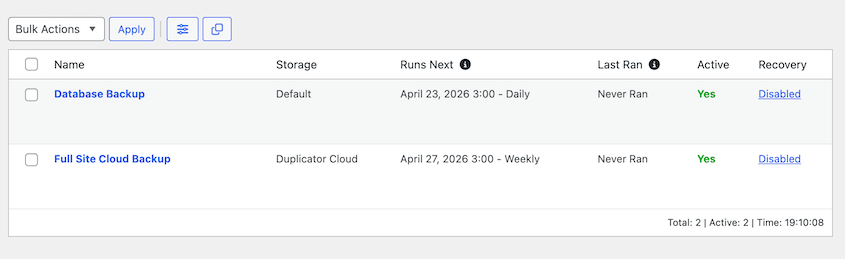
Duplicator really shines when used in conjunction with OneDrive.
This complex, fully automated backup method for all of my more than 60 client websites begins with integrating OneDrive into Duplicator Pro — an absolutely essential interface.
For someone managing 60-plus clients by himself, the time he got back was invaluable.
Results
With Duplicator, Jürgen was able to:
- Cut project transfer time from 2-5 hours down to 15-20 minutes, even on larger projects
- Move large, media-heavy sites without the manual, supervised batch transfers they used to require
- Avoid database-compatibility problems, including migrating formats like MySQL to MariaDB
- Automate monthly backups across 60-plus client sites, saved to the client’s server and Jürgen’s OneDrive at once
- Pull external client sites into his development environment for redesign work
- Run a 60-plus-client web design business alone, alongside a full-time career in cybercrime prevention
Nine Years, Still Running Solo
Nine years after finding Duplicator, Jürgen is still running appareas webdesign by himself, relying on the same tool to make that possible.
Duplicator has played a major role in my company’s success and growth, and it helps me with complex tasks literally every day.
Running a one-man agency means every hour is precious. Duplicator Pro gives Jürgen back the hours he used to lose to slow transfers, hosting mismatches, and backups he used to have to babysit himself.
While you’re here, see how Duplicator has transformed other businesses’ workflows:
- How a One-Man Web Agency Saves 10% of Revenue with Duplicator
- How a Web Design Agency Completes 50 Migrations a Month
- How an Indie Author Conquered His Fear of Website Migrations
- How a Web Design Agency Avoided Migration Failures Across 50+ Projects
- How Rock Lobster Webdesign Boosts Design Efficiency With Duplicator